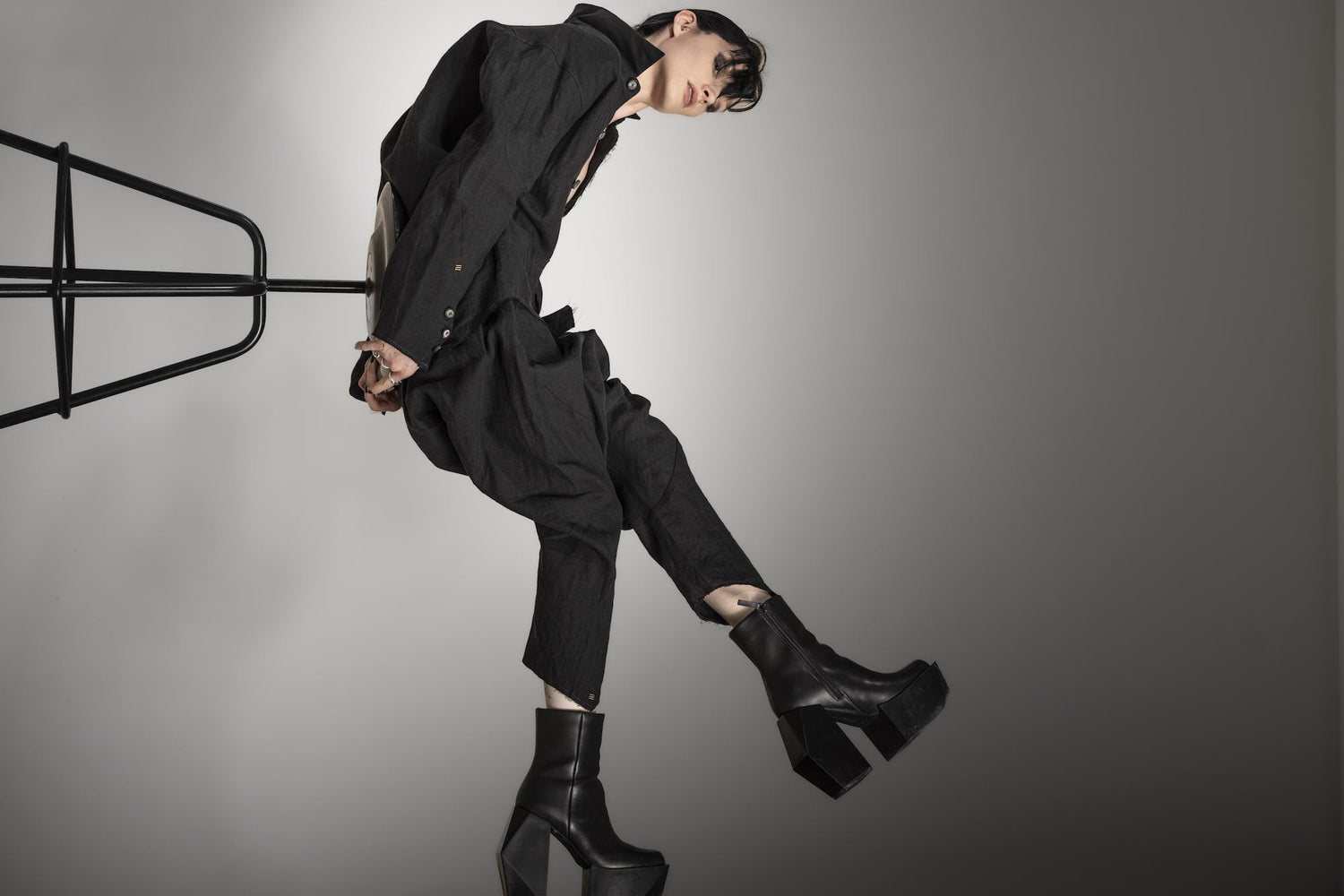
An Ode to Shadows
Our modern era harbors a peculiar affinity for the sleek and smooth. You encounter it in the seamless glass facades of contemporary cities, in the calculated symmetry of digital imagery, and in the flawlessly pressed off-the-rack suits of the corporate world. Everything appears optimized, fine-tuned for flawlessness, and hermetically sealed.
Yet, this relentless perfection fatigues the eye. It is sterile. A space without shadows allows for no depth; a form without a fracture leaves no room for character to breathe. This architectural and societal slickness is met with a quiet, persistent defiance—an imperceptible stepping out of the rhythm of our times. In Japanese philosophy, this mindset finds its expression in Wabi-Sabi—the profound aesthetic appreciation of the imperfect, the impermanent, and the unrefined. It is the acceptance that nothing in this world is ever truly complete.

The Sound of the Blemish
The Japanese writer Jun’ichirō Tanizaki articulated this ethos in his essay In Praise of Shadows. In it, he describes, almost tenderly, how objects—be they silver, wood, or jade—only reveal their true beauty once the luster of the new has faded. He speaks of the "glow of antiquity," of that delicate patina forged by the touch of human hands over the years.
This aesthetic of the imperfect runs through all the disciplines that touch us to our core: We would rather listen to the gravelly, life-worn voice of a Tom Waits or the fragile melancholy of a Billie Holiday than to a flawlessly calculated, studio-polished pop song. For it is precisely this subtle crack in the tone, the audible exhaustion of a breath, that suddenly reminds us of our own vulnerability.
Where perfection distances us and leaves us mute, the flaw creates an intimate complicity: We are no longer merely listening to a performance; we are tuning in to a life fully lived, one that has become tangled in the vocal cords. It is a quiet rejection of the acoustic norm. The Arte Povera movement, too, deliberately turned its back on elitist marble to seek out the raw, unpolished honesty of felt, wood, and iron.
„True elegance does not lie in flawlessness. It lies in the poise with which we carry our fractures."
From Illusion to Essence
From Illusion to Essence
Those who perceive clothing merely as a status symbol take refuge in the illusion of invulnerability. The garment becomes a suit of armor, intended to project flawlessness, wealth, and an almost defiant permanence. Yet, this desperate preservation of the new is, ultimately, a form of sealing—it traps a person in a rigid, unapproachable shell.
The aesthetic of Wabi-Sabi quietly turns away from this compulsion to perform and represent. It counters a loud need for validation with humility, seamless perfection with intimate permeability, and the longing for permanence with a silent acceptance of the ephemeral. It is by no means symmetry itself that constricts us, but merely its hermetic closure. Even a strictly calculated, symmetrical design begins to breathe the moment it is no longer entirely sealed. Where a raw edge opens up a view, a rough texture catches the shadow, or a fabric takes on its first traces of wear, mere display gives way to true being.
It is not without a certain irony that designing the imperfect demands the highest level of discipline. Positioning a raw edge so that it frays organically without compromising the garment's quality tolerates no negligence.

Men’s Black Designer Shirt in Premium Cotton

Avant-Garde Designer Baggy Cotton Jeans in Dirty Grey

Distinctive Designer Biker Jacket in Soft-Touch Denim in Dirty Grey

Women’s Designer Suit with Barrel-Leg Pants in Luxury Wool

Extravagant Women's Pantsuit in Italian Wool with Barrel-Leg Pants

Designer Barrel Leg Trousers for Women in Italian Wool

Women’s Sartorial Pantsuit in Luxury Italian Wool with Pleated Pants

Architectural Women’s Pantsuit in Italian Wool with Pleated Trousers

Black Designer Oversized Hooded Coat in Japanese Wool Blend

Unconventional Black Designer Women’s Jacket with Stand Collar in Italian Wool
Calculated Imperfections
In our Viennese atelier, we meet this paradox with profound craftsmanship. Guided by a master tailor who has cultivated her trade for four decades, the apparent fracture evolves into an act of sartorial precision. One must master the strict rules of classical tailoring in all their depths to be able to deconstruct them aesthetically and with absolute command.


This mindset calls for materials that reject perfectionism just as steadfastly as their wearers do.
At eigensinnig wien, we therefore work with natural fabrics that possess a life of their own. Linen, for instance, is the material manifestation of Wabi-Sabi. It cannot be forced into a smooth shape. It wrinkles, it creases, and it fights back against the heat of the iron. With every wear, it grows softer; it memorizes movements and, in a sense, only truly comes alive on the body.